The ZEC was the fastest workhorse after the Democrats took back the Senate.
Both traditional markets and crypto bled in Tuesday’s election. But once Democrats won the Senate, markets soared, with ZEC far surpassing the crypto majors.
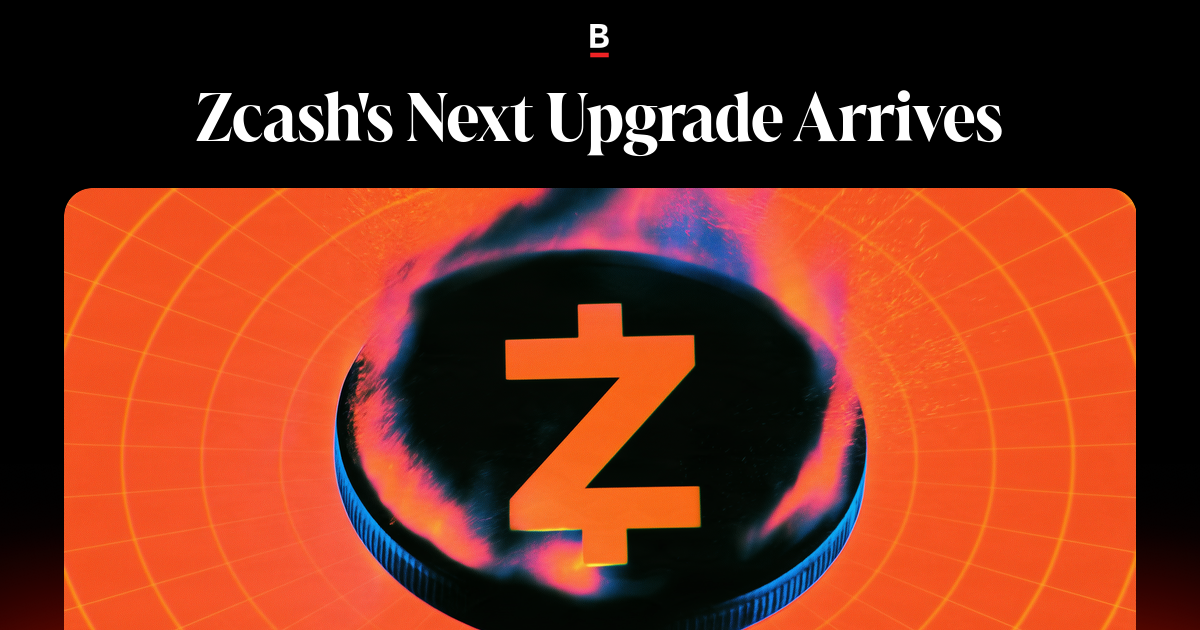
Tonight, Zcash is enjoying a potential new boost with NU7, its next major network upgrade. Set to activate at block 3 543 405NU7 addresses some of the practical issues hindering Zcash’s growth: slow confirmations, low transaction throughput, outdated infrastructure, and the way the network pays miners as rewards decline.
Let me explain what the upgrade brings and how it fits into the broader Zcash roadmap.

Basically, NU7 brings four changes:
First, speed. By reducing the time between blocks, Zcash payments can receive their first confirmation on average in 25 seconds, instead of 75. This brings Zcash closer to its goal of becoming usable digital money, while improving transfers such as exchange deposits and movement between chains.
Since blocks remain the same maximum size, producing three times as many blocks triples the network’s raw throughput. But that doesn’t mean three times more private transactions. NU7 also limits the amount of protected activity each block can contain, so the capacity for new Orchard transactions increases by approximately 2.3 times.
Second, guarantees. Protected transactions use zero-knowledge proofs, which are more demanding for nodes to verify and for wallets to recover. Without protections, attackers could flood blocks with transactions that slow down nodes or overwhelm wallets with data to sift through. The new caps aim to prevent this as the network speeds up.
Do you like this article?
Subscribe to Bankless or log in
The third is the Network Sustainability Mechanism, or NSM. Like Bitcoin, Zcash relies on miners to secure the network. Their income in new coins and transaction fees constitutes its security budget. As block rewards continue to halve, these payouts could eventually become too small to keep enough miners participating, making attacks cheaper.
To anticipate this, NU7 will give miners 40% of the transaction fees and set aside the remaining 60%. This ZEC is actually stored; it is temporarily removed from circulation and will gradually return in the form of additional mining rewards starting from around February 2031. In other words, the network is saving some of today’s fees to help pay for its security tomorrow, without changing Zcash’s roughly four-year halving schedule or the 21 million ZEC cap.
Finally, there’s some fall cleaning. Zcash launched Sprout, its first protected pool, in 2016. Since then, new pools like Sapling, Orchard, and Ironwood have made it largely obsolete. The last managed wallet supporting Sprout was already outdated, but keeping the old system in the protocol further adds complexity and security risks.
NU7 completes this takedown by banning all v4 transactions, the only format that can spend Sprout funds. As of Thursday morning, approximately 12,200 ZECs remained in Sproutand these parts will become unusable unless a future upgrade creates a recovery path. This ban also covers older Sapling and Transparent v4 transactions, so wallets that still build them will have to migrate to newer formats. Existing Sapling funds remain usable once the wallet is upgraded.

Sponsored: Need a ZEC wallet? Use our Zcash wallet of choice: Vizor. Learn more about visor.cash.
Overall, NU7 marks the next step in Zcash’s greater ambition to transform the protocol into one capable of handling transactions at the scale of a consumer payments network.
This obviously requires more than producing blocks faster. As Zcash co-founder Sean Bowe and ZK researcher Dev Ojha explain in Monday’s episode, the network also needs to make private transactions easier to process, help wallets track much higher activity, and improve the way blocks flow across its proof-of-work network. I highly recommend checking out the episode or, at the very least, reading Peaster’s overview of the full roadmap to this conversation.
The Complete Zcash Roadmap | Sean Bowe and Dev Ojha on Bankless
What would it take to make private money work on a global scale?
Without a bank

The biggest effort that remains to be made is TachyonBowe’s overhaul of the cryptography behind Zcash’s private payments. Today, nodes verify a separate zero-knowledge proof for each protected transaction and store an ever-growing list of voiders so that the same funds cannot be spent twice. Tachyon aims to consolidate several of these proofs into one and allow nodes to shed most of this historical overhead, thereby lifting two of the major throughput caps. Along the way, the redesign provides a cleaner path to the post-quantum privacy Zcash is striving to achieve. There is no activation date yet.
There is also work beyond Tachyon. Wallets still need a way to trace incoming payments without analyzing every transaction, and researchers are pushing private information recovery (PIR) for this. The network also needs faster block sharing as volumes increase. This is all still in development.
The market came to Zcash before NU7. ZEC has led the post-Senate rally, and tonight’s upgrade gives that attention something real to highlight: faster confirmations, more room for private transactions, and a plan to pay miners as block rewards decline.
None of this addresses whether Zcash can function as private money at scale. NU7 is buying some room until Tachyon hopefully removes the cap. Until there is a date, the best Zcash can hope for is that the momentum continues.
I hope that will be the case.
About the Author