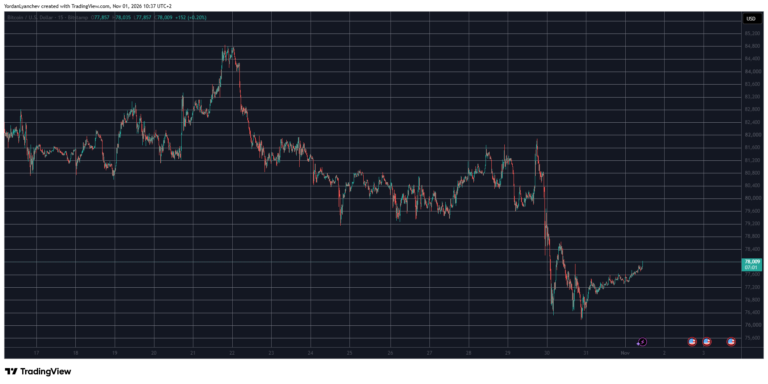
As a new cycle appears to be underway, there are legitimate concerns around Bitcoin that are worth considering, and I’m not just talking about quantum vulnerability.
Me, and that it seems, others on the timeline, have raised the possibility of BTC underperforming in the coming cycle, similar to how most alts failed to reach significant new all-time highs in the last cycle.
With Bitcoin already on the rise, you might think I’m crazy. But listen to me.
— (@)
Bitcoin is mainstream
The last cycle was primarily about the “integration” of Bitcoin.
It started with the approval of spot ETFs, which opened up Bitcoin to institutional capital and did so with enormous success, with BlackRock’s IBIT becoming the Fastest ETF Never to reach $10 billion in assets. Then Trump ran and won on a platform that included the creation of a strategic Bitcoin reserve, another catalyst that helped push Bitcoin into six figures. During this time, Saylor was buying millions of dollars of BTC every week, a shopping spree that inspired other companies to become digital asset hoarders and join him in these weekly purchases. The fact is that Bitcoin has spent the cycle dramatically increasing the number of people and institutions that could own it. No other crypto asset has received such broad support, on or off the markets.
However, I’m now having a hard time seeing who will still participate. DAT trading has largely collapsed. The BSR has mostly disappeared, with the government until now relying on seized BTC rather than making outright purchases. Those wishing to purchase Bitcoin can already do so through ETFs. I don’t mean that supply is disappearing, just that the opening of these channels was in itself a catalyst, and it cannot simply be repeated.
Instead of entering this cycle with another massive pool of buyers waiting to be unlocked, Bitcoin faces uncomfortable headwinds. Most annoying to me is the unresolved quantum question, where a sufficiently powerful quantum computer could derive the private key from the public key and spend Bitcoin to manage the controls. Yes, Bitcoin developers have proposed defenses, including BIP-360, but there is still no adopted network-wide migration.
How Strategy Can Sell Billions More in Bitcoin on Bankless
The strategy sold $216 million worth of Bitcoin to fund dividends, but still reports a total reserve capacity of $1.25 billion. Explanation of the gap between construction and reconstruction.
Without a bank
Then we have the overhang of the strategy, which Saylor attempts to maneuver like an actively managed fund, balancing Bitcoin holdings with shareholder demands, preferred dividends and debt payments – and no longer simply going all out to “stack sats”. Strategy has previously sold BTC to fund distributions, while management itself now describes the company as moving from one-way issuance to “active capital management.” Rather, the strategy provides the perfect transition to the most difficult problem facing Bitcoin: a cultural problem.
The cultural problem of Bitcoin
Bitcoin was born as a currency outside of the traditional financial system. Today, fund managers gobble it up, repackage it, charge fees and resell the exposure to investors. There is an obvious advantage to this. I like being able to buy Bitcoin in an IRA. But there’s also something undeniably strange about seeing the financial system that Bitcoin was designed for become one of the primary ways people access it. And take advantage of it.
Sixsmith, whose ra recent piece helped get started this current of thought has recently formulated cultural criticism with greater acuity: “Bitcoiners started believing that Bitcoin had already accomplished the mission, and then they sold it.”
I think this view is more widely held than many realize, and Zcash’s outperformance is symptomatic of this. David Hoffman made a similar argument around the institutionalization of Bitcoin, toning down its cypherpunk side: Zcash has the same basic monetary foundation, including a 21 million supply cap and proof of work, but adds native privacy, something Bitcoin has never achieved in any meaningful way and something that arguably makes Zcash more resistant to absorption into the traditional financial system in the same way.
Do you like this article?
Subscribe to Bankless or log in
Building the Zcash thesis in 2026 on Bankless
ZEC’s second major breakthrough has many advantages.
Without a bank
He also showed himself more willing to confront the quantum directly through Tachyonits proposed next-generation shielded protocol, designed to pave the way for post-quantum privacy.
In this context, I would not be surprised to see remarkable reflexivity on the part of Zcash: the more it appreciates, the more people question Bitcoin; the more they question Bitcoin, the more capital moves to Zcash, and so on. I think Zcash might surprise people with how much of Bitcoin’s monetary premium it can capture. Hopefully, this competition will also scare the Bitcoin developer community into approaching quantum with the urgency it deserves.
— (@)
Alts finally have fundamentals
But I don’t want to just bash Bitcoin. There is an equally compelling argument for the alternatives, which in some ways can simply be reduced to this: They have matured.
We really have Hyperliquid to thank for demonstrating how important the fundamentals that support a token can be to its trajectory. Crypto companies are now generating significant revenue, and many of the largest companies have made channeling that revenue back into their tokens a priority. Hyperliquid is the archetype: around 97% of protocol fees are spent on HYPE redemptions, with cumulative purchases already well over $1 billion. As Evan_ss6 shared in his latest article, buyouts have become a big enough trend that the Financial Times now they follow them.
Beyond that, Uniswap uses protocol fees to buy and burn UNI, while Lighter channels all of its revenue into LIT buybacks. Aave automated its buyback program last year, and Pompe.fun also actively buys PUMP. Ethena is implementing hers.
The result is something that crypto has historically lacked: tokens tied to businesses where greater usage can actually translate into greater demand for tokens or reduced supply. And these companies still have enormous room for growth. The CFTC has already paved the way for crypto perpetuals to reach US customers through regulated venues and intermediaries, while the SEC’s new innovation exemption allows limited on-chain trading of US rights-holding stocks via authorized AMMs.
The SEC has just opened a legal path for tokenized stocks on Bankless
The SEC’s new innovation exemption allows authorized AMMs to trade tokenized and rights-bearing U.S. stocks for the first time.
Without a bank

Products that were inaccessible or legally uncertain to U.S. users last cycle are starting to open up. This gives companies like Hyperliquid, Lighter, Uniswap and others something that Bitcoin is increasingly lacking: truly new markets in which to expand.
And I’m not talking about all alts. The opportunities seem increasingly concentrated in the “good” ones: companies are already generating significant revenue from products that people actually use, with mechanisms linking that success to their tokens and the large markets they have only just begun to penetrate.
This is ultimately the thesis. Bitcoin doesn’t need to crash. It can appreciate significantly and still underperform. But while the last cycle turned around Bitcoin, this cycle could much more revolve around a handful of assets whose addressable markets are currently expanding.
About the Author