I’ve always had a soft spot for DeFi x NFT crossovers, and there’s a particularly intriguing one brewing on Robinhood Chain this week.
The project, The standard reservewants to become a new type of sovereign chain banking system. This is of course an experiment, but it has the potential to generate a lot of activity, so let’s revisit the big ideas here.
What’s new
The standard reserve is provided de facto central bank protocol that will answer to no one, only to its programmable on-chain monetary policy.
Created by developer 0xBeansTSR is kicking things off today with its Genesis Charter Mint.
The Standard Reserve arrives September 14.
Both audits found no critical vulnerabilities, reports will be made public before launch.
More details to come in the coming days. pic.twitter.com/ylv6F7BVbB
– The standard reserve (@standard_rsv) September 10, 2026
Why it, how it works
Consider what we’ve seen before with reserve currency plays like Olympus DAO and OHM, i.e. issues printed on a fixed schedule regardless of demand, selling pressure outpacing buyers, then a downward spiral, etc.
TSR’s response to this old pattern? Make your own show sensitive instead of being programmed, by tying it to a main signal, namely ETH flows, instead of a predefined curve.
As such, the entire TSR system is designed to operate on a single market, which is an ETH/STANDARD pool on Uniswap v4 governed by a custom hook. In each epoch, this hook measures the net flow of ETH into and out of this pool.
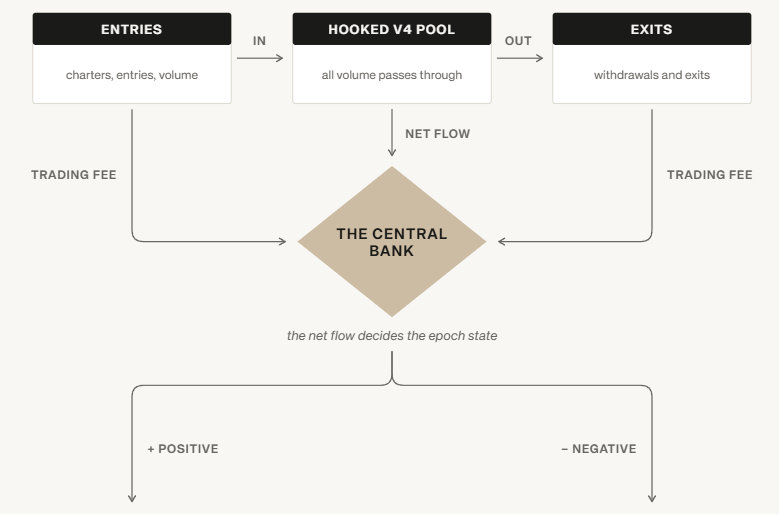
Positive flow triggers expansionthat’s to say emissions spike and fees are funneled into a vault that buys tokenized gold and deepens liquidity. Negative Flow Triggers contractionthat is, emissions are immediately reduced and fees turn into buybacks and burns.
STANDARD itself is the native currency of the protocol, capped at 1 billion tokens. 100 million of them are permanently blocked as liquidity owned by the protocol and the remaining 900 million are in reserve as issuance budget.
Do you like this article?
Subscribe to Bankless or log in
Notably, these tokens are only issued when someone withdraws, and they burn constantly thanks to buybacks, exit fees, and TSR’s licensing system, which I’ll explain below.
Charters and branches
TSR’s NFT item is linked to its Charterswhich are soul-bound NFTs that give you the role of “banker”.
In other words, these non-transferable assets are licenses to earn a share of the protocol’s issuance. There are 1,000 founding charters (some authorized, some public) published at the time of genesis. The green list opens at 5:30 p.m. ET with a Liquidity fee of 0.15 ETHwhile all remaining spots will be sold via a downward public auction in the Netherlands starting at 8:30 p.m. ET at 1.25 ETH and falling towards a floor of 0.15 ETH. At 9 p.m. ET, the auction ends, liquidity is added, and STANDARD trading opens. 100% of the coin’s proceeds go to the initial liquidity and protocol vaults, with none going to the team. New charters can then be auctioned daily in ETH, although these auctions will not be enabled at launch.

It is important to note that each charter opens with a bifurcate and can reach 10, and each additional branch must be purchased with an expansion license, paid in full in STANDARD and burned on site. The specific advantage? “Each branch is a part of the problem of each era.” according to the white paper.
As a result, the smartest move an existing banker can make, opening more branches, is also the protocol’s main lever to reduce supply.
To cash out, bankers must close a branch, which sends your share of the accumulated balance in your wallet, minus a resolution fee that varies depending on how much of the system is trying to exit at one time.
Half of the resolution fee is spent, while the other half is paid to the remaining bankers. This dynamic reverses the incentive for a bank run, as those who rush to exit end up paying those who remain steady.
Zoom out
We will have to see how this planned flywheel behaves following the release of its monetary machine through its charters, extensions, etc.
Can TSR avoid the graveyard of reflexive conceptions of the OHM lineage? Can this become a tour de force on Robinhood Chain? Can STANDARD attract bankers consistently over the long term?
Only time will tell. But I admire 0xBeans’ previous work and think the banking licensing NFT model here is smart and innovative. Keep this one on your radar now that the launch is in motion.