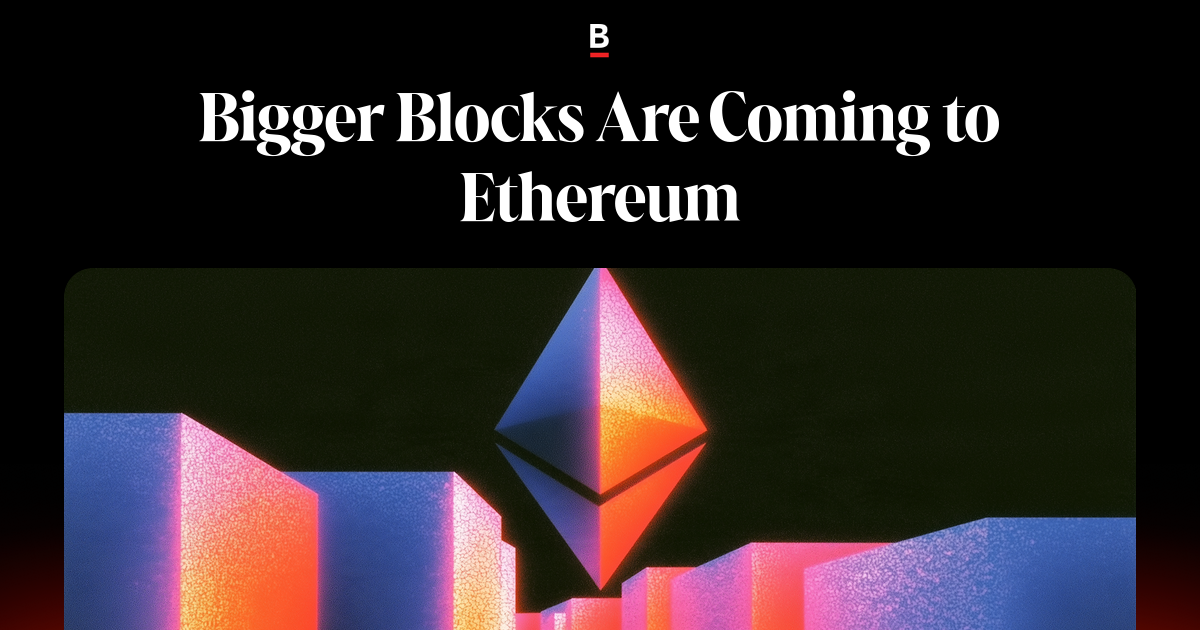
Gloas for the consensus layer; Amsterdam for the execution layer. Put them together and you get Glamsterdam, Ethereum’s next major update, which notably just passed its first primetime test.
Indeed, Glamsterdam went live on the Sepolia testnet yesterday, October 6, with the chain finalizing blocks to failover without any critical issues.
It’s just a testnet activity for now, of course. But what this bodes big for the OG smart contract network. As Barnabé Monnot, researcher at Ethlabs, told the news:
— (@)
Toni Wahrstätter, researcher at the Ethereum Foundation echoes this sentimentalso, calling Glamsterdam the opening for Ethereum’s “largest throughput increase since launch.”
Indeed, by the numbers, Glamsterdam is built for a gas limit of around 200 million, a jump of around 3.3 times from today’s 60 million in a single upgrade. For perspective, the mainnet was sitting at 30M for years before validators took it to 60 million over three bumps in 2025, and even doubling the maximum block size in the 2021 London upgrade kept the target at 15 million.
Yet the fork itself will not flip a switch that would instantly make Ethereum 3 times larger. Instead it will change how blocks are created in such a way that much larger blocks can be produced safely, and then validators will decide whether or not to increase the limit.
With that said, let’s break down here what’s changing specifically for Ethereum and what’s left ahead of mainnet.
Fork beams 18 EIB in total, but three of these proposals will do the heavy lifting.
The first, of course, is established separation of the applicant and the manufactureror ePBS for short. To oversimplify, this mechanism will grant Ethereum validators more time.
Today, most Ethereum blocks are built by specialized builders and then transmitted to validators via trusted intermediaries called relay. With EIP-7732 (ePBS), the offeror instead commits to a builder’s signed offer, and the builder reveals the full package After.
This means that the act of verifying a block’s transactions no longer has to be crammed into the roughly 4-second attestation window. According to the EIP, most validators will now have around 9 seconds instead.
The next important pillar coming to Glamsterdam will be block-level access listsor BAL. In short, these lists will offer a new capacity to parallel work.

As a reminder, today, Ethereum clients mainly go through a block’s transactions one by one, because they cannot know in advance what each of them will touch. So EIP-7928 (BAL) will each block the ship with a map of all the states it touches, as well as the values afterwards.
Do you like this article?
Subscribe to Bankless or log in
With this guide in hand, customers can pre-fetch data and validate transactions in parallel. To use a factory metaphor, ePBS is like giving quality control more time for inspections, while BALs give the floor everything it needs so that multiple assembly lines can operate at the same time.
In addition, larger contracts, plus some repricingarrive. EIP-7954 is set to increase the maximum contract size from 24 KB to 64 KB, easing a cap that has long forced large applications to split their code.
Meanwhile, the fork will increase the price of what is supposed to be rare, i.e. the new state. Below EIP-8037creating a new storage slot goes from 20,000 to 97,920 gas, while a simple transfer of ETH to an existing account remains at 21,000 gas EIP-2780.
Sepolia’s first Glamsterdam block landed yesterday with a gas limit of 60 million, which is the same cap as the Ethereum mainnet today. From there, Sepolia’s limit hit the 200 million target around 11 hours after the fork and has held that mark ever since.
The nominator of each block can only increase the gas limit by about 0.1% per block, so if each the nominator had pushed him each block, Sepolia could have made the trip in about 4 hours. It took more than twice as long, probably in part because two popular consensus clients, Prysm and Teku, kept validators at 60 million after the fork, unless they explicitly opted for 200 million.

The aforementioned Wahrstätter has since shared the first numbers which suggests that the levers are already bearing fruit. He found that each client now runs each unit of gas faster than before the fork, for example, a 40 million gas block that took Geth around 115ms to execute now takes around 30ms.
That’s less than a day’s worth of data from one node per client, but it’s definitely a promising start.
As for what’s coming followingWith Sepolia out of the way, it’s Ethereum’s Hoodi testnet that’s on the list for Glamsterdam’s subsequent deployment. The date of October 27 has been tentatively set for this activation, but this is not yet set in stone, and mainnet remains a target for some time in Q4 2026.
Also remember that Glamsterdam was originally scheduled for the first half of 2026 and Sepolia’s range slipped from August 3 to October 6. So it’s entirely possible that the timeline will fluctuate further from here.
Certainly, we will be faced with new dynamics and new questions with the arrival of Glamsterdam.
For example, some Ethereum tools will break if they don’t stay up to date with fork changes. The FE has warned that wallets, indexers and gas estimators that assume a maximum gas limit will need to be updated to avoid issues.
Additionally, with repricing around state growth, on-chain activity that creates many new accounts or storage (e.g. airdrops, mints, and new wallets) will pay more, while daily transfers will not.
Yet these subtleties will turn out to be minor points. The widest and most significant The dynamic at work here is that Ethereum L1 is about to get a lot more spacious, and that’s great news for experiments across the Ethereum ecosystem, whether big or small, TradFi or weird.
For example, last August I noticed that Fake World Assets had briefly become the largest gas guzzler on the mainnet on one of its craziest days. Glamsterdam should give such surges much more room to breathe without excluding everyone.
In other words, Ethereum leaves more room for more dreams, more projects, more activity. Now let’s see how the Ethereum community can serve both old needs and new purposes.
About the Author