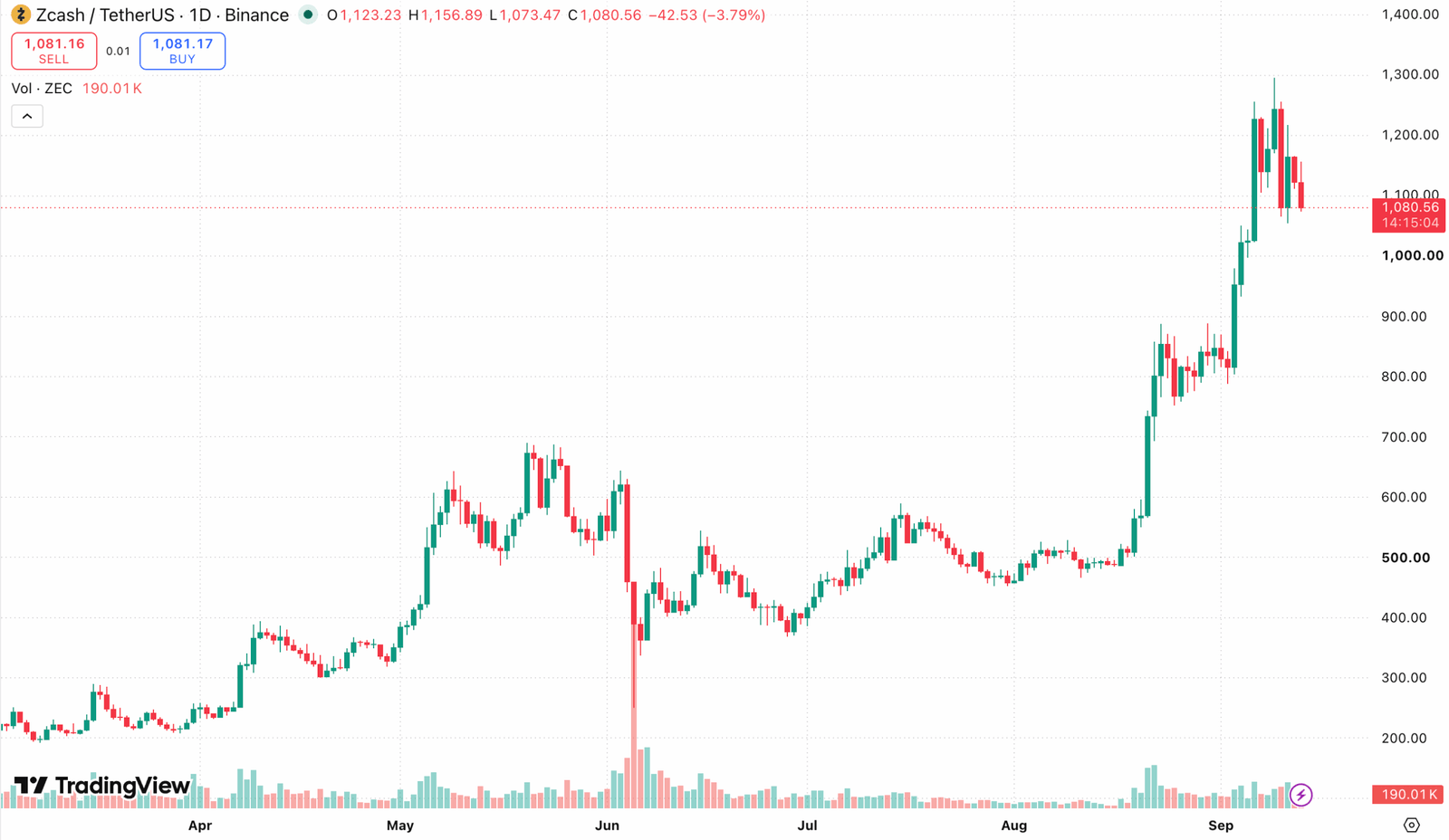
ZEC’s most recent rise, which took it to nearly $1,300, managed to reignite considerable comparisons between it and Bitcoin – especially because both have a maximum supply of 21 million coins.
However, prominent analyst filbfilb says the adequacy of circulating supply alone says very little about valuation. He has developed a series of models that attempt to better quantify how much of the Bitcoin network value Zcash has actually managed to gain.
The analyst compared ZEC with Bitcoin using metrics such as transaction activity, value transferred, circulating supply, as well as potential future convergence between the two networks.

Current Activity Suggests Bullish Bias May Be Exaggerated
Zcash currently has just under 17 million coins in circulation, which is approximately an earlier milestone in Bitcoin’s issuance history.
But instead of simply applying Bitcoin’s valuation at that moment in time to ZEC, filbfilb adjusted it based on relative network usage.
At the equivalent issuance stage, Zcash’s TX activity amounts to approximately 3.71% of that of Bitcoin. When this percentage is applied to Bitcoin’s historical market capitalization, the result produces an implied ZEC price of approximately $254.
A second model now compares the two networks. Currently, Zcash processes approximately 1.01% of the number of Bitcoin transactions, which when applied to BTC’s current market cap gives an implied value close to $944 per ZEC.
As you can see, both of these numbers are below ZEC’s recent high.
ZEC privacy changes the calculus
Filb notes an obvious weakness when applying the transaction counting model: a $10 transfer and a $10 million transfer each count as a single transaction. The model therefore also takes into account the monetary value transferred through each network.
Zcash complicates this calculation. In fact, protected transactions hide the transfer amounts. It assumes that 58% of transactions are protected and that the average protected transaction has the same monetary value as an observable transaction.
Under these assumed conditions, Zcash achieves approximately 12.34% of the equivalent transfer value of Bitcoin, compared to only 3.71% using the previous model.
The combination of these two measures also results in an estimated network progression of around 8.03%.
Convergence is important
This is where the numbers get considerably higher.
If the current Bitcoin network valuation is treated as a potential long-term destination, the transaction-only model results in a price of approximately $3,457 per ZEC in a hypothetical 100% Bitcoin value capture scenario.
Once it mixes the privacy-adjusted transaction and transfer model, it comes to around $7,480, while the 25% and 50% capture assumptions assume $1,870 and $3,740, respectively.
It’s also important to note that these are just scenarios. These are not price targets or probabilities. He also highlighted some limitations, including differences between architectures, as well as the inability to measure protected transfer values.
The takeaway is that ZEC, at current highs, already looks relatively expensive compared to what its network has achieved today. Whether this valuation ultimately changes depends on whether the cryptocurrency can continue to close the gap with Bitcoin.
The post Can Zcash really keep up with Bitcoin? This Model Puts ZEC to the Test appeared first on CryptoPotato.