
Hyperliquid has done +$2 billion in redemptions to date, Pump.fun +$7 million so far this week. Some projects TO DO make money through crypto, and increasingly, they are turning to funneling revenue directly to holders as part of their tokenomics.
For example, Aave automated its buybacks last year, Uniswap extended its buy-and-burns throughout 2026, Pendle now distributes 80% of its protocol’s revenue to sPENDLE holders, and Ethena is currently voting on enabling its own fee switch for buybacks.
Ethena Fee Vote Ties ENA Buybacks to USDe Growth on Unbanked
Ethena’s fee change vote comes with a proposed revenue scale tied to USDe.
These are just a few of the projects doubling down here right now, which isn’t surprising since capturing value for a token makes said token more attractive to users. socket. To stand out in a sea of thousands of coins, many of which are static and offer no utility, you need to give people a reason to hold, that is, a dynamic coin that is continually driven by income.
In the context of DeFi, DefiLlama defines plain income a bit like “gross revenue” in TradFi, i.e. “the share of fees that (a) protocol keeps for itself”. What we are specifically talking about above (e.g. buybacks, burns, distributions, etc.) is what DefiLlama calls income of holdersi.e. “how much value (a) protocol distributes to its investors”.
This latter measure is a more recent invention, but it is useful and worth monitoring closely in the future, as the trend of value returning in crypto shows no signs of slowing down.
The number of defi protocols distributing money to holders via dividends or buybacks has only increased https://t.co/XPtSUq5WGd pic.twitter.com/JwgMFOMMfF
Do you like this article?
Subscribe to Bankless or log in
– 0xngmi (@0xngmi) August 28, 2026
Of course, as I mentioned, holders’ income can take different forms. Ethereum simply burns a reduction in ETH fees. Uniswap uses its profits to finance UNI purchases, SO burns the UNI. Pendle funnels a large portion of its revenue to its investors. As for Aave, it buys AAVE but holds the following tokens in a reserve for now.
As a result, there is no “right path” here, but the most dominant one in terms of size today is buyouts. By DefiLlama 3 of the 5 best projects by holder income, namely Hyperliquid, Pump.fun, and Chainlink, combined to return approximately $30 million to their respective holders via redemptions in the last week alone. The other projects in the top 5, Canton and Tron, opt instead for burning.
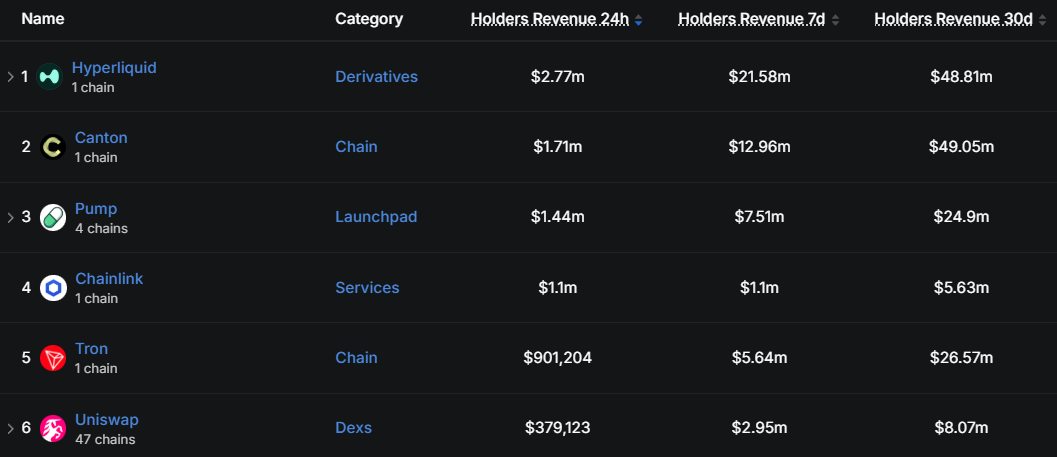
Now is a good time to look at this ranking, not only because it can give you ideas for dynamic coins for your portfolio, but also Also because new projects and new fee switch activations (e.g. Ethena TBD) can change its composition overnight. For example, as I mentioned in my previous article, Fake World Assets has recently rebounded among the top 10-20 holder income projects, despite only launching a month ago on Ethereum.
Whether projects meet and deliver on their commitments will also be increasingly important as a monitoring point. For example, the new Universal Token Ratings measure projects through the “Disclosure” and “Performance” components, and the consideration of buyouts/burns (and their correspondence with public declarations) is weighted in the performance rating.
It’s not a huge weighting, but it can definitely make a difference. Is it a coincidence or more that the only AAA coin today, UNITEDis at the heart of one of the largest holders of on-chain revenue generating systems today?
You can draw your own conclusions, but either way, holder earnings will only become more important in the future, so be sure to keep this metric on your radar in the months to come.