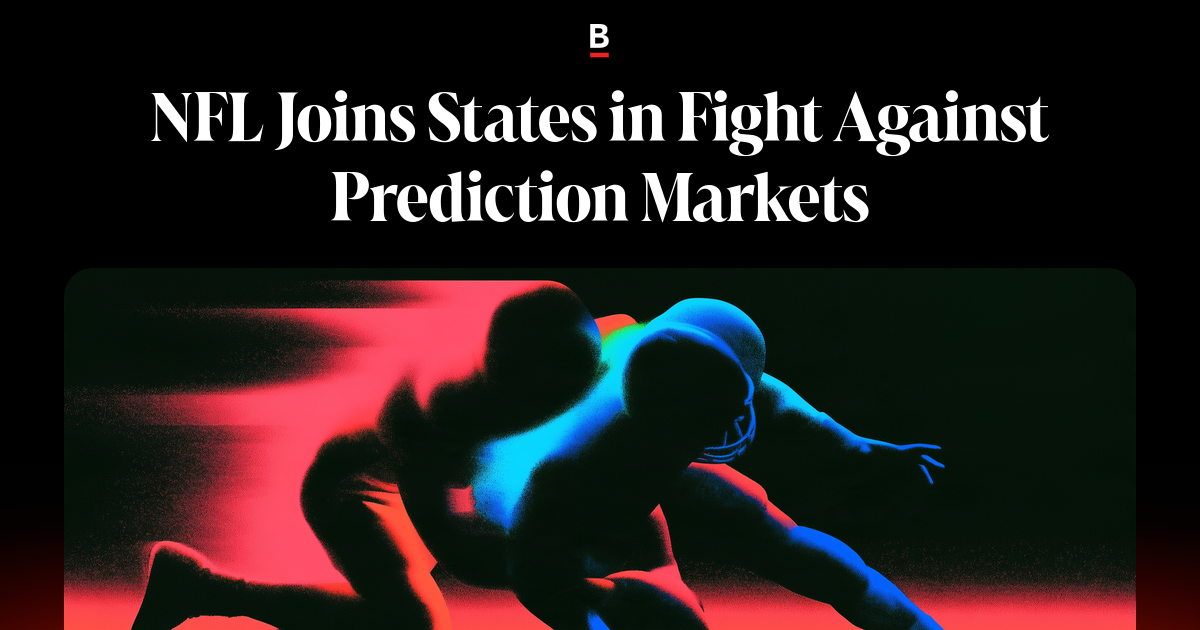
The NFL has taken sides in the growing legal fight over prediction markets, backing New Jersey against Kalshi and amicus brief filed Thursday ask the Supreme Court to review the case.
The league argues that sports contracts constitute gambling and that letting prediction markets offer them outside of state gambling laws threatens the integrity of the game and consumer protections.
This is a sharp escalation by the NFL, which has spent months directly raising concerns about prediction markets while exploring partnerships with them.
And with the NBA also evaluating its own prediction market deals before the season opens Oct. 20, its decision could add additional pressure on the Supreme Court to take up the case.
— (@)
The filing follows discussions between the NFL and Kalshi and Polymarket over which contracts should be allowed on their platforms.
In March, the league sent letters to prediction market operators asking them to ban the types of bets they considered particularly vulnerable to manipulation: contracts such as those related to player injuries, officials’ decisions, or individual plays that a single person could influence.
The league too pressed the CFTC to introduce stricter safeguards in May and argued in July that the agency’s proposed rules fell short of the protections already required for traditional sports betting.
In September, the NFL was repeating his complaintssaying contracts reported months earlier were still being offered, while keeping the door open for commercial partnerships. According to Sports at receptionthe league had been in discussions with Kalshi, Polymarket and the CFTC for months, but no partnership materialized before the start of the season.
In a CNBC interview published September 11Commissioner Roger Goodell confirmed the league is still talking with operators about changes that could make them potential partners.
The NFL had cited inadequate regulation and legal uncertainty This is why he was not ready to sign a deal, although the details of his private discussions remain unclear. Such a partnership could further allow the NFL to become more directly involved in monitoring market integrity, as well as licensing, data and marketing agreements.
Despite this, the league has now supported New Jersey’s argument that the federal Commodities Act does not prevent states from regulating sporting event contracts as gambling.
As we saw previously, the federal appeals courts are already divided on this issue, with the Third Circuit supporting Kalshi and the Sixth and Ninth Circuits siding against it.
Do you like this article?
Subscribe to Bankless or log in
The Supreme Court has not yet agreed to hear the case.

The NFL’s position contrasts with several other major sports organizations that have adopted prediction markets.
THE NHL partners with Kalshi and Polymarket last October, while CFU And MLS then signed agreements with Polymarket. In March, MLB followedin partnership with Polymarket and signing a separate agreement with the CFTC to strengthen market integrity.
Meanwhile, the NFL has stuck with traditional sports betting partnershipsrenewing deals with DraftKings and FanDuel while adding Fanatics in August.
Oddly enough, DraftKings, FanDuelAnd Fanatics also operate prediction market products, meaning the NFL’s partners create businesses in the market whose regulation the league challenges.
This market is also important. In Thursday’s briefThe NFL said $1.8 billion of the $3.3 billion traded in prediction markets on the season’s opening Sunday involved NFL games, more than half of that day’s trade.

And while the NFL has made its case to the Supreme Court, the NBA remains undecided.
In September, Front Office Sports Reported that the league had circulated partnership proposals to several operators, including Kalshi, Polymarket and Fanatics, with terms of the deal apparently on the table.
But the NBA has also spent more than a year raising similar regulatory concerns. In May 2025he has called for stricter oversight of prediction markets and, more recently, Julyargued that the CFTC’s proposed rules failed to provide basic protections against insider trading and market manipulation.
Yet, like the NFL before Thursday, the NBA has not sided with the states on the legal issue. In Aprilhe explicitly refused to take a position on whether sports prediction markets legally constitute games of chance.
The NFL has followed a similar path, pushing for stricter regulations while exploring partnerships. With no agreement reached before kick-off, the league has now taken the next step.
With NBA opening night is approachingthe question is whether the league follows suit.
If a partnership comes to fruition, the NFL would remain a notable obstacle among these major leagues, although a deal with the NBA would not necessarily mean abandoning its regulatory concerns.
But if negotiations fail, the NBA could follow the NFL in supporting the states, given its own long-standing concerns about market integrity. That would put both leagues on the same side against Kalshi’s contention that federal law takes precedence over state gaming rules, adding weight to the push for Supreme Court review.
The NBA could also continue to push for stricter rules without taking a legal stand. But after watching the NFL move from regulatory complaints to a Supreme Court filing, it’s becoming increasingly difficult to ignore another major league following suit.
About the Author